Nature Full of Life How to Describe Composition in Art
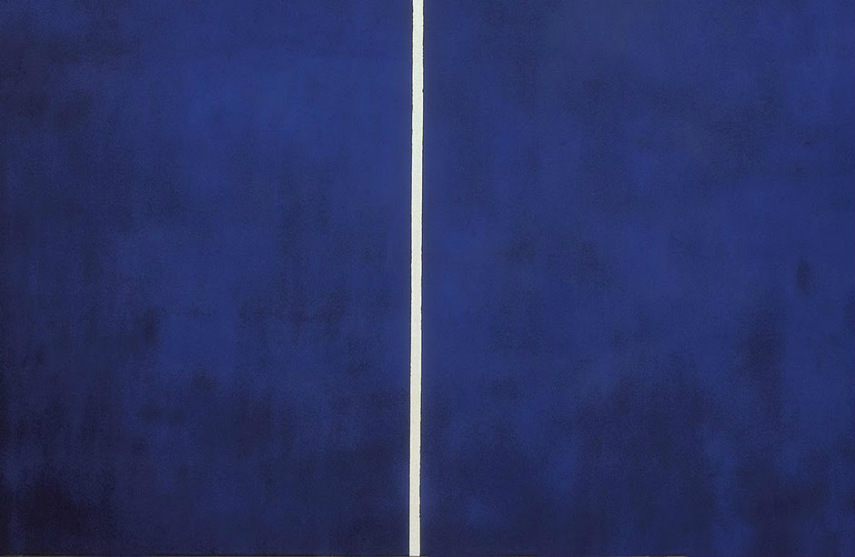
Limerick in fine art stands for an ordering of artistic elements in a unifying mode that makes a terminal result constructive. This may mean that a work of art is aesthetically satisfying, only often in modern and contemporary fine art this includes achieving additional goals such as existence politically provoking, or disruptive of dissimilar visual or social tropes. The difficulty in defining composition comes from these sometimes mutually sectional positions. Can a limerick at the same time be visually pleasing while its conceptual potential remains undisturbed? It seems that such questions were obsolete in previous centuries when art served as a representational tool of different religious and social dogmas. Rules of symmetry and convention guided artisans, although today some of the best works from the by are considered to be the ones that disobeyed such rules. Modernistic and gimmicky scene seems to preserve adherence to compositional rules, although contextual meanings surrounding it oft bear on the readings of such works. Minimalism of Barnett Newman 'zips' are a expert example of how compositional simplicity can represent circuitous ideas engaged with the problematic of the everyday. In order to better understand the importance of composition in fine art we look at its meaning, elements, and politics.
What is Composition in Art?
The term limerick means 'putting together' or 'the human action of combining parts or elements to form a whole', and through these explanations much tin can be ended what composition in art stands for. It can exist but defined as the arrangement of visual elements according to the principles that were established in visual practices over the centuries. Although some of the principles changed with time, the careful and thought-out placement of elements plays an integral part in every successful limerick, beingness that of visual arts, music or writing. Sometimes term composition is used interchangeably with other terms such as structure, ordering, or design. At that place are distinctions between conventional and unconventional compositions, and most of the conventional ones can be accomplished with the techniques such as rule of thirds, dominion of odds, rule of space and simplification, among others.
Rule of thirds is linked with the sectionalization of an epitome into thirds horizontally and vertically in guild to avoid bisecting which is not very visually pleasing. This dominion as well helps in determining where the focal indicate should be placed in order to achieve a dynamic composition. Rule of odds relates to a number of subjects on an epitome, and reflects the idea that odd number of subjects is more than interesting than an fifty-fifty number. Rule of infinite provides the contextual background for the represented topic and is often relative to spatial illusion. Simplification is some other postulate that basically suggests that each image should comprise merely the necessary subjects equally also many may distract the viewer from the depicted theme.
Elements of Composition
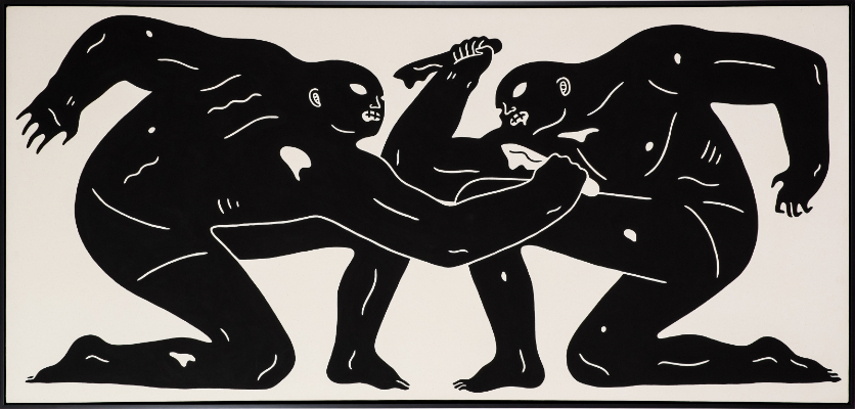
In order to organize visual components in an artwork, artists usually follow some of the compositional rules that would make the piece of work more than appealing or intriguing to the viewers. Limerick gives layout and construction to each fine art piece, and besides affects the way the subject area is perceived and understood. Information technology leads the middle of the observer through the image and emphasizes the focal point. In Western fine art there are some general elements of composition that throughout the centuries were the guiding points for artists in achieving successful visual presentation.
Residual provides a sense of equilibrium or dynamism depending on whether symmetrical, asymmetrical or radial balance is practical. Unity links all elements of limerick together, but sometimes parts can be made to look out of place. Motility relates to a sense of motility achieved through the arrangements of objects that guide the viewer'due south eyes, while rhythm is a more generalized 'beat' of an artwork. Focus is related to all the elements being arranged as to point to one spot, and if this element is not present the piece may seem to lack in unity and dynamics. Contrast and pattern are of import every bit long as the motion and rhythm are concerned. They relate to night/light and color contrasts, or repetition of lines, shapes or colors. Finally, proportion affects how things chronicle to one another regarding size, distance, and scale.

Politics of Limerick
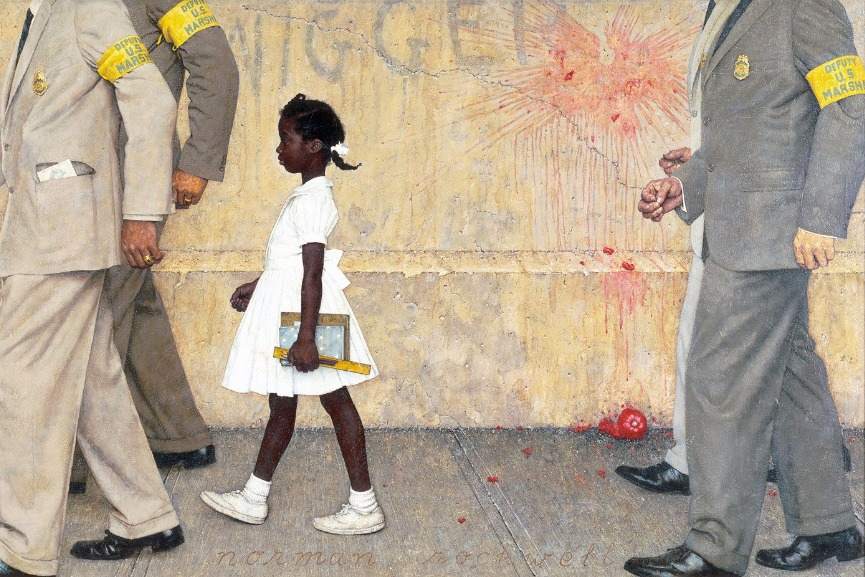
Although limerick in art is defined through well-thought principles and techniques that follow some strict rules of observation, we should never forget the conceptual meanings hiding behind certain compositional choices. How world is represented in art? Even when we talk nigh multiple worlds, the ones created by artists or the real or metaphysical worlds that stand for with our behavior or living realities, the modes of their compositional renderings are rarely or about never cleared of politics. The compositional spaces in visual arts are inhabited by subjects, themes and motifs bundled in a mode that infuse additional meanings, provoke, pacify or disturb our habitual iconographies, which translates them from pure visual into political expressions. It is almost incommunicable to notice in the history of art works which compositional principles were not guided by some additional political reasons beside the aesthetic ones. Rancière's explanation of politics uncannily resembles postulates described above. For him "politics exists when the figure of a specific subject is constituted, a supernumerary subject in relation to the calculated number of groups, places, and functions in a society." [i]Similarly, composition depends on a number of elements of which politics of representation is its constitutive element.
Compositional Symmetry of Classical Beauty and Duchamp's Wheel
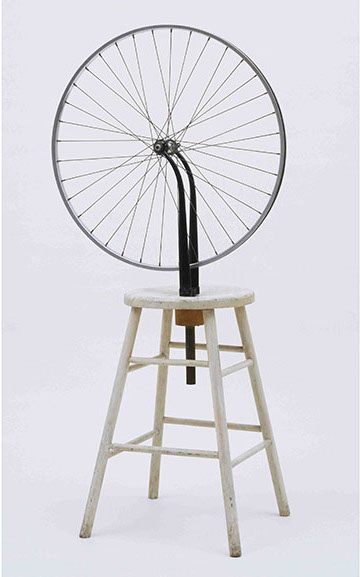
Starting with nature, symmetrical patterns seem to be influencing artists throughout history, and accept been an important factor in shaping of our environments and societies. Beauty and symmetrical compositions seem to exist traditionally linked, although never fully explained. Canon of beauty in classical antiquity constituted of symmetry found in nature and arts.[two]Platonic divine world was in the Middle Ages likewise conceived as symmetrical, with portal compositions of many churches sculptured in this manner. Philosophers and modernistic artists tried to give their explanations of dazzler plant in symmetry, and they usually linked it with happiness. Arthur Schopenhauer explains how the contemplation of natural forms, which are regularly symmetrical, tin be a tool of escaping the painful daily experiences. [3]Marcel Duchamp'southward similarly talks near the issue the observation of his ready-made Bicycle Wheel produced in him: "To see that cycle turning was very soothing, very comforting, a sort of opening of the avenues onto other things than the material life of the everyday." [4]The beauty of the limerick can be divers through the happiness he felt in observing it.[5]
Disturbing Social Decorum and Serra'due south Tilted Arc
Compositional choices do non always invoke beauty and harmony. More oftentimes, they seek to disturb the viewers in their sedimented positions and learned modes of observation. Peculiarly in modern and contemporary art such choices abound. While dazzler and compositional symmetry seem to become manus in paw, so practice the uneasy and unsettling issue of sure compositions, and catharsis, or revelation of sure social truths. Aristotle in his Poetics explains that tragedy equally a dramatic class often stimulates negative emotions in the public, such as fright or pity, merely this is not necessarily negative as such emotions are by the terminate of the play purged from the viewers, making them happier and healthier. The cathartic effect a disruptive functioning can have, similarly translates to the effect of disruptive compositions in visual arts.
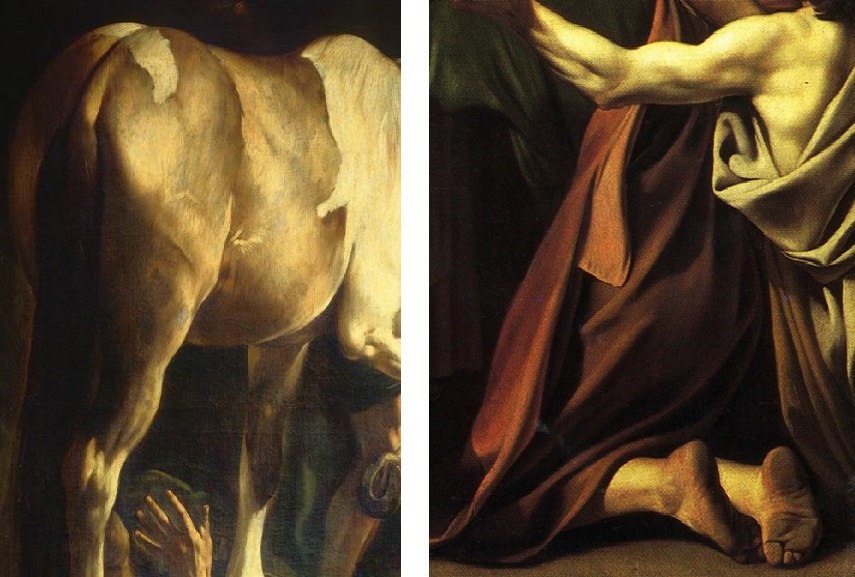
Going into the past we come across how Caravaggio'southward selection - in the paintings Crucifixion of St Peter and Madonna di Loreto - to put in focus the backside of a equus caballus and dirty feet of a person crouching in the front, acquired an uproar when they were made. The creative person's conclusion, nonetheless, is believed to exist justified by the need to represent 'existent' persons in religious compositions and to make them more than relatable to ordinary people.[six]While Caravaggio opened religious imagery to paupers, artist Richard Serra 's Tilted Arc was created with an thought to provoke reflection amongst the citizens of New York well-nigh the urban surroundings, restricted movement, and liberty. In the artist's words:
the viewer becomes aware of himself and of his movement through the plaza. As he moves, the sculpture changes. Contraction and expansion of the sculpture result from the viewer'south motility. Step by step the perception not merely of the sculpture but of the entire environment changes.[7]
However, the work that comprised of a single long unfinished plate of COR-X steel, 37 m long, and 3.7 m loftier positioned on the Foley Federal Plaza provoked a lawsuit. This simple compositional solution of placing a plate on a public square finished in dismantling of the sculpture, and its removal as numerous citizens and officials plant information technology disruptive of their learned patterns of movement around the plaza.
The Importance of Composition and Its Principles
It is not an overstatement to say that every artwork has a good composition at its cadre. This does not necessarily translates into aesthetic terms, but it is often so. Besides beingness a ruling principle in ordering of elements of art into a unifying whole, limerick also actively defines conceptual meanings behind each slice. Historical as well every bit modern examples given above showed united states of america how compositional solutions affected the understanding of art, from linking it to abstract concepts such as dazzler, to leading to social deportment when an artwork interfered with habitual spatial movements of a group of people. Its significance is never defined solely through a single dominion. A combination of historical besides as gimmicky understandings affects how we perceive and value composition. Without it, we would inappreciably be able to talk about the artworks and fine art. In nature, structuring of forms adheres to certain rules of system as a guiding norm of every creation, and fine art, defined from aboriginal times in relation to nature, follows the similar models in achieving visual unity.


Editors' Tip: Composition in art
A painting'southward technique and perspective may all be first-class, yet the painting will fail unless its limerick succeeds. Composition is the harmonious arranging of the component parts of a work of art into a unified whole. Henry Poore examines the works of sometime masters and moderns in this book and uses these examples to explicate its principles in art. All the paintings that the writer analyzes are illustrated in the text-166 illustrations, including nine in full colors. Thirty-two diagrams past the author accompany his textural word of such topics every bit the importance of rest, entrance and exit, circular observation, angular composition, limerick with ane or more units, and light and shade.
References:
- Rancière J., (2006), The Politics of Aesthetics, p.116.
- Osborne H., (1986), Symmetry as an artful factor, Computers & Mathematics with Applications, Vol. 12, Issues ane–two, Office B, p. 77.
- Jacquette D.,(1996), Schopenhauer, Philosophy and the Arts, p.118.
- Coffin T.A., Symbol of Beauty: Symmetry in Art and Nature , www.arthistoryarchive.com [Dec 21, 2016]
- Ibid.
- Gibbons A., (2016), Caravaggio In Rome: Violence, Fine art, Dirty Feet , writingcities.com [December 21, 2016]
- Michalos C., (2007), Murdering Art: Destruction of Art Works and Artists' Moral Rights, in: The Trials of Art, pp.173-193.
Featured images: Richard Serra - Tilted Arc, 1981. Paradigm via pintrest.com; Wassily Kandinsky - Composition X, 1939. Prototype via ibiblio.com; Chartres Cathedral, Tympanum Sculpture over the Purple Portal, 1194. Image via counterlightsrantsandblather1.blogspot.rs. All images used for illustrative purposes only.
0 Response to "Nature Full of Life How to Describe Composition in Art"
Post a Comment