Please Check the Card Number on Visa Ending in and Try Again Walmart Grocery
Typing a xv-16 long cord of numbers without a single error can be challenging for virtually users – yet, it's what all users have to do during the checkout flow as they reach the 'Credit Bill of fare Number' grade field. During our big-scale checkout usability written report we observed that a large sub-group of users struggle with correctly typing their 15-16 digit credit card number, and subsequently struggle with verifying that it's typed correctly. During testing this was observed to exist the direct cause for checkout abandonments as users got card validation errors due to elementary typos.
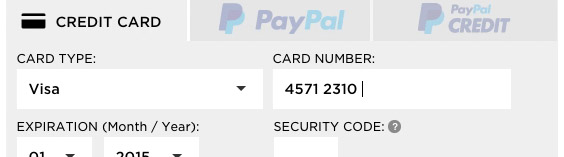
The long 15-16 digit credit carte du jour number is very prone to typos and we observed 23% of users to either type or verify their carte number in distinct 4-digit blocks – identical to the physical print on nearly credit cards.
Our test sessions also revealed that allowing users to type spaces and car-formatting their menu number with spaces can profoundly improve users' accuracy when typing their credit menu number, and help them to more easily cheque that their typing is valid. Nevertheless, our research also show that lxxx% of due east-commerce sites currently don't apply this powerful typing assist for their credit bill of fare field.
In this article we'll therefore present our test findings on the following:
- How users blazon their card number and why 23% of users are observed to blazon or verify their card number in distinct four-digit blocks.
- Why it causes severe usability issues when sites disallow spaces in the card number input (never exercise this!).
- How auto-formatting spaces was observed to lift input accurateness and lower abandonment rates due to fewer card validation errors.
- How the technical implementation should handle card types with "odd" formatting (AMEX, Diners, etc).
Why 23% of Users Type or Verify Their Menu Number in iv-Digit Blocks
There are ii fundamental examination observations as to how users behave a) afterwards having typed their carte number, and b) when typing their carte du jour number.
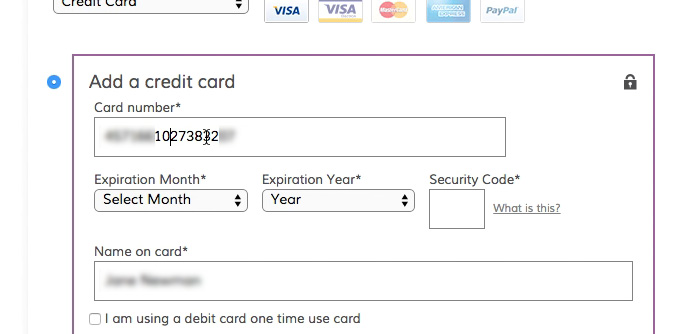
"I always check. I only check on the card that the numbers are right… I click between [every 4th digit, ed.] then I tin can gauge it." This discipline explained her method for checking to make sure that the card number is inputted correctly. Note the placement of the cursor in the card number string.
Firstly, during testing, subjects tended to be extra careful when inputting their card number. Oft nosotros observed that exam subjects, afterward having inputted their credit bill of fare number, double-checked it to brand sure the information technology was right earlier submitting the form. A single typo when transferring the 15-sixteen digit numeral string printed on the concrete card into the card number class field volition cause a validation mistake. But in practice it's oft worse than just an mistake.
Many users have – likely due to poor prior general checkout experiences, typically on other sites – come up to suspect that a card validation error may besides clear out all of their typed card data, hence a transposed digit will forcefulness them into re-typing their total credit card data. Indeed our checkout benchmark reveals that even among the fifty top-grossing US e-commerce sites, 18% still clear out the user's unabridged card number on just the smallest typo.
It's therefore not that surprising when nosotros during testing observed a sub-grouping of users meticulously double-checking their card number after having typed it by nearly always looking from the physical carte du jour to the typed number on the screen, and using the mouse cursor to inspect the typed number in 4-digit blocks.
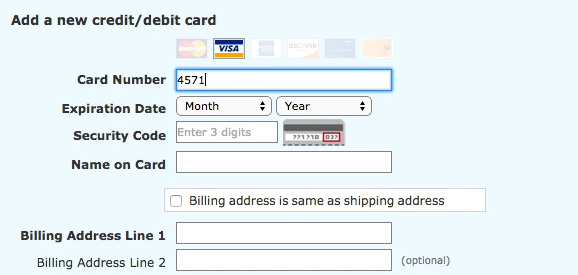
At Walmart, this test bailiwick has begun to enter his credit card number. The subject would enter 4 digits from his card into the "Carte du jour Number" form field, then look down at his credit card for the next 4 digits, enter those, and and then on until the entire number had been entered. Several subjects "chunked" the carte number into 4-digit groups, rather than entering all 16 digits in i go.
Secondly, besides double-checking their card number after entry, the test subjects were often observed to enter their number in the same format in which it is embossed or printed on their physical carte du jour. For virtually credit cards (although non all), this is a 16-digit string with spaces between every fourth digit (afterward in the article nosotros'll elaborate on the cards that deviate from this design).
During testing, 23% of the subjects were observed to type and/or verify their menu number in these distinct 4-digit blocks. Yet many sites returned validation errors whenever these subjects also typed in spaces, something we found to exist a major source of usability issues.

"If we assume the menu is working then I've typed something wrong – but otherwise it's considering information technology's an invalid card. So I actually can't get whatever further." This exam discipline had entered a space after every 4th digit in her card number. After trying to submit the course, she received a validation error (due to the spaces), but assumed the validation fault was due to the card being rejected and concluded upwards abandoning the order.

"I've typed spaces in between [every 4th digit, ed.], like at that place is on the menu. I thought they should be there, since it's on the card." This examination discipline began to enter the credit card number, calculation a space afterwards every four digits. When she wasn't able to enter the unabridged number – as American Eagle has a 16-digit character limit on the field – she became dislocated, unsure of what was wrong.
Card numbers on concrete credit cards frequently contain spaces to help make the number string easier to read. Users sometimes interpret these spaces as being role of the number string and are liable to include them when they are inputting their credit card numbers into the "Carte du jour Number" field. Yet, some sites do non let spaces in the menu number field, resulting in validation errors for users who simply blazon exactly what they encounter on their menu. Combined with the oft highly generic card validation fault letters (see Ameliorate Validation Errors with Adaptive Messages), this tin can effect in checkout abandonments, as seen in the test session example above.
Permit Users to Type Spaces
As a first foundational stride, information technology's crucial that users are allowed to include spaces in the "Bill of fare Number" field. Allowing spaces in the card number input ways that users can type exactly what they see printed on their physical card. As a nice bonus, it also makes it a lot easier for the user to validate their card number input. "4571661027381607" is but more difficult to visually validate than "4571 6610 2738 1607".
Within the "Bill of fare Number" field spaces should not provoke validation errors or be stripped from the displayed input. If your card payment processor doesn't accept spaces submitted, then the spaces can instead automatically be removed before submitting the form to the server (only create a JavaScript EventListener that binds to the course and then apply a regular expression to detect and wipe out any whitespace characters in the card number input just earlier it gets sent along to the server for processing).
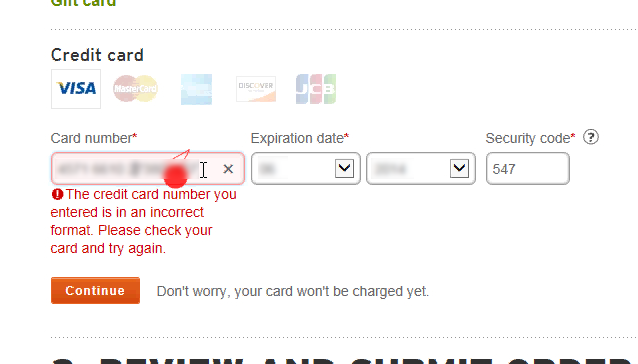
Another subject encountered a card validation error at REI considering he'd accidentally added an extra "0" in the credit card number. He tried adding a space after every fourth digit, however, there was a character limit on the field then after adding the 3rd space nothing happened. Highly confused, he began looking at the other credit card fields and re-read the error message. Unable to spot the error he concluded upwards submitting the incorrect input 3 times in a row.
Additionally, some sites, rather than provide an fault, simply limit the allowable characters in the "Card Number" input field. This is not recommended. Besides inherently disallowing spacing, it tin can also take desperate consequences for a smaller sub-group of users since not all card numbers are 16 digits long. While most credit cards are 16 digits, there is variance: AMEX is 15 digits, VISA has reserved the right to use 13-19 digits, Maestro 12-19 digits, Solo and Switch take 16, 18, or 19 digits, China UnionPay has xvi-19 digits, then on. A forepart-finish character limitation, in practice, is spring to also completely lock out the few users with a carte du jour number length that deviates from the norm.
Auto-Format the 'Menu Number' with Spaces


"It merely formats it all," a test subject said, positively surprised as he had entered his 16-digit VISA number (left), and Walmart then auto-formatted it with spaces for every 4-digit chunk (right).
It is articulate from the test sessions that users aren't merely highly likely to brand typos in their card number – it's also difficult for them to subsequently validate this error-prone input. All the same, when testing sites that auto-formatted the user'due south carte du jour number with spaces, the subjects were observed to experience a combination of easier right typing of what they saw printed on their credit card, and easier subsequent validation of what they had typed.
Consequently, the subjects experienced fewer payment validation issues on sites that auto-formatted their card number input with spaces compared to those sites that didn't. Therefore, if the user is typing a VISA or MasterCard card number, the input should be car-formatted to include a space for every fourth digit.
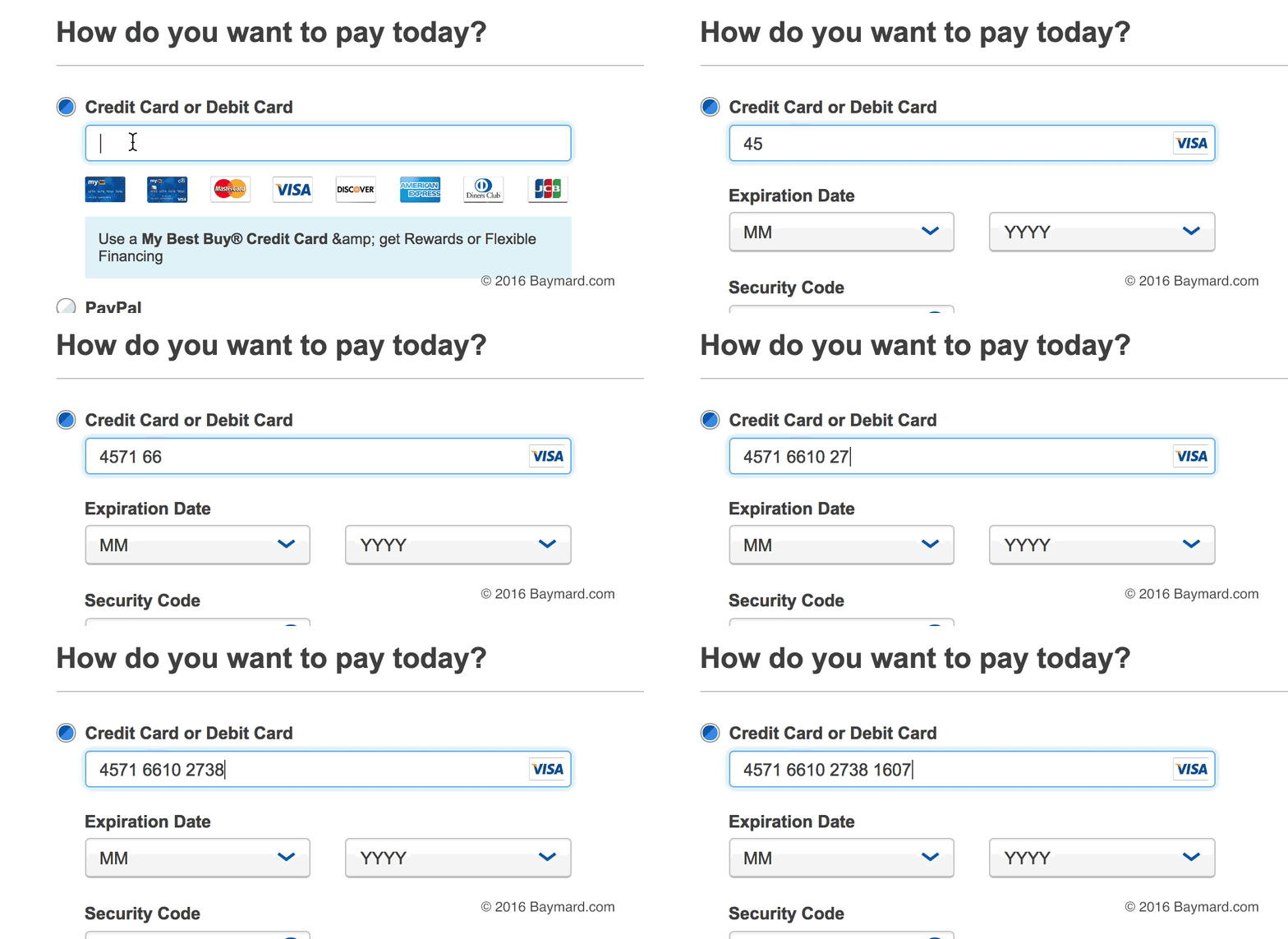
BestBuy auto-formats the user's credit card number as it is entered.
Auto-formatting menu numbers should ideally be accomplished live while users enter their card number (also known as an "input mask"). Input masking offers the benefit of allowing users to more hands check the card numbers because spaces are added while they enter them. Additionally, input masking alerts users to the fact that the card number will exist formatted for them. If the number isn't formatted until users leave the field they may not know that the motorcar-formatting will occur. Without live formatting, users may enter spaces needlessly (although spaces should of grade never cause bug regardless of the input mask).
It'south worth noting how the concept of making the card input closely resemble what's printed on the user'south physical carte was too observed to utilise for "Expiration Appointment" drop-downs, every bit we covered in Format the 'Expiration Date' Fields Exactly as the Credit Menu (40% Get information technology Wrong).
Some Carte Types Deviate from 4-Digit Chunking
When venturing into supporting machine-formatting of spaces, it should be noted that credit card issuers employ different space-formatting schemas. While the vast bulk of cards and card types use 16 digits, chunked into iv-digit sequences – like all VISA, MasterCard, Discover, and JCB cards – a few card types deviate. The most important difference is the xv-digit AMEX number which uses a 4-6-5 chunking. Whatsoever 19-digit credit card number by and large uses iv-4-4-4-iii chunking.
Much like we did for our list of Cart Abandonment Charge per unit Statistics, we've gathered information on a bunch of different carte du jour types and created a reference table you can utilize to implement card number automobile-formatting. The table includes carte du jour number length, IIN ranges, and spacing patterns for twenty unlike card types.

To make it easier to implement this auto-formatting feature, we've created a reference table with the IIN Ranges and Spacing Patterns of 20 different card types.
This means that the formatting of spaces, primarily for AMEX card inputs, has to change based on the card type. Luckily the card type tin can be motorcar-detected based on the get-go digits in the card number, where AMEX cards start with either "34" or "37". To ensure a good return on investment, consider just supporting car-formatting for the virtually common 15- and 16-digit cards, like VISA, MasterCard, JCB, Find, and AMEX (and/or any card types that are especially popular on your site). Given the rarity of cards that deviate from these 2 patterns, just allowing users to type spaces themselves will have to do for the "odd ones out" cards (typically information technology's Switch, Solo, Maestro, Diners enRoute, Diners Club, and Menu Blanche, that deviate).
Auto-Formatting the 'Carte du jour Number' Input with Spaces
Considering that we found v% of US users have abandoned one or more checkouts in the by quarter solely due to credit card validation errors, information technology'southward staggering that 80% of sites don't actively aid their users to more than accurately type and validate the 15-16 carte du jour number input. Especially given the mistake-prone procedure of transferring the card number printed on the physical card to the on-screen class field.
At the near basic level all sites should allow users to type spaces in the "Carte Number" field. That means sites should neither disallow the specific "space" input grapheme nor fix an input length limitation (eastward.grand., limiting the field to sixteen characters).

Ideally, the concept is taken farther past auto-formatting all users' "Carte Number" inputs with spaces, knowing that this leads to fewer bill of fare validation errors – both because information technology increases the user'due south accurateness when typing the card number and makes it easier for them to spot any typos afterwards. For sixteen-digit cards like VISA, MasterCard, Discover, and JCB this ways auto-calculation a space for every 4th digit users type. For fifteen-digit AMEX cards the auto-spacing should apply a 4-6-5 pattern instead.
This article presents the research findings from just one of the 580+ UX guidelines in Baymard Premium – become total access to learn how to create a "State of the Art" cart and checkout user feel.
koehlereigerstand.blogspot.com
Source: https://baymard.com/blog/credit-card-field-auto-format-spaces
0 Response to "Please Check the Card Number on Visa Ending in and Try Again Walmart Grocery"
Post a Comment