The Great Mosque at Djennãƒâ© in Mali Is Quizlet Art

Peachy Mosque of Djenné, Mali, 1907 (photo: Mark Abel, CC Past-NC-SA 2.0)
As one of the wonders of Africa, and one of the well-nigh unique religious buildings in the world, the Slap-up Mosque of Djenné, in present-twenty-four hour period Mali, is also the greatest accomplishment of Sudano-Sahelian architecture (Sudano-Sahelian refers to the Sudanian and Sahel grassland of Due west Africa). It is also the largest mud-built structure in the world. We experience its monumentality from afar as information technology dwarfs the city of Djenné. Imagine arriving at the towering mosque from the neighborhoods of low-rise adobe houses that comprise the city.
Djenné was founded between 800 and 1250 C.E., and it flourished as a great center of commerce, learning, and Islam, which had been proficient from the kickoff of the 13th century. Soon thereafter, the Slap-up Mosque became ane of the most important buildings in town primarily because information technology became a political symbolfor local residents and for colonial powers like the French who took control of Mali in 1892. Over the centuries, the Great Mosque has go the epicenter of the religious and cultural life of Republic of mali, and the community of Djenné. It is also the site of a unique annual festival called the Crepissage de la Grand Mosquée (Plastering of the Great Mosque).

Keen Mosque of Djenné, Republic of mali, 1907 (photograph: herr_hartmann, CC BY-NC 2.0)
The Great Mosque that we see today is its 3rd reconstruction, completed in 1907. According to fable, the original Swell Mosque was probably erected in the 13th century, when King Koi Konboro—Djenné'south twenty-sixth ruler and its first Muslim sultan (king)—decided to use local materials and traditional blueprint techniques to build a identify of Muslim worship in town. King Konboro's successors and the town's rulers added two towers to the mosque and surrounded the main building with a wall. The mosque compound connected to aggrandize over the centuries, and by the 16th century, popular accounts claimed one-half of Djenné'due south population could fit in the mosque's galleries.
The first Nifty Mosque and its reconstructions
Some of the earliest European writings on the get-go Great Mosque came from the French explorer René Caillié who wrote in detail about the construction in his travelogue Journal d'un voyage a Temboctou et à Jenné (Journal of a Voyage to Timbuktu and Djenné). Caillié traveled to Djenné in 1827, and he was the only European to see the monument before it fell into ruin. In his travelogue, he wrote that the edifice was already in bad repair from the lack of upkeep. In the Sahel—the transitional zone between the Sahara and the humid savannas to the south—adobe and mud buildings such every bit the Bang-up Mosque crave periodic and oftentimes annual re-plastering. If re-plastering does not occur, the exteriors of the structures melt in the rainy season. Based on Caillié'southward description, his visit likely coincided with a menstruation when the mosque had non been re-plastered for several years, and multiple rainy seasons had probably done away all the plaster and worn the mud-brick.

"The Old Mosque Restored," from Félix Dubois, Timbuctoo the Mysterious (London: William Heinemann, 1897), pp. 157.
A second mosque built betwixt 1834 and 1836 replaced the original and damaged building described by Caillié. We can encounter evidence of this construction in drawings past the French journalist Felix Dubois. In 1896, three years after the French conquest of the metropolis, Dubois published a plan of the mosque based on his survey of the ruins. The structure drawn by Dubois (in a higher place) was more compact than the ane that is seen today. Based on the drawings, the second construction of the Not bad Mosque was more than massive than the first and divers by its weightiness. It also featured a serial of depression minaret towers and equidistant pillar supports.
The present and third iteration of the Cracking Mosque was completed in 1907, and some scholars fence that the French constructed it during their catamenia of occupation of the city starting in 1892. Yet, no colonial documents back up this theory. New scholarshipsupports the idea that the mason's guild of Djenné built the current mosque with the help of forced laborers from villages of adjacent regions, brought in by French colonial regime. To accompany and motivate workers, musicians were provided who played drums and flutes. Workers included masons who mixed tons of mud, sand, rice-husks, and water and formed the bricks that shape the current structure.
The Great Mosque today

Roof (detail), Great Mosque of Djenné, Mali, 1907 (photo: un_photo, CC By-NC-ND 2.0)
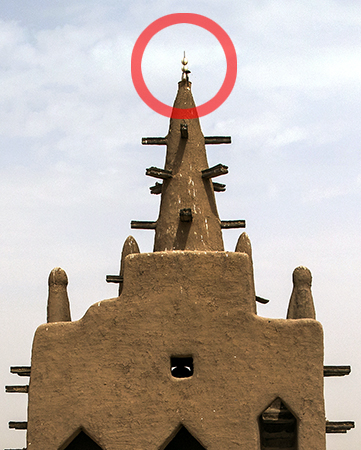
Ostrich eggs circled in cherry (detail), Groovy Mosque of Djenné, Mali, 1907 (photograph: un_photo, CC BY-NC-ND 2.0)
The Smashing Mosque that we encounter today is rectilinear in plan and is partly enclosed by an outside wall. An earthen roof covers the edifice, which is supported by monumental pillars.
The roof has several holes covered past terra-cotta lids (above), which provide its interior spaces with fresh air even during the hottest days. The façade of the Great Mosque includes iii minarets and a serial of engaged columns that together create a rhythmic consequence (beneath).
At the summit of the pillars are conical extensions with ostrich eggs placed at the very height—symbol of fertility and purity in the Malian region. Timber beams throughout the exterior are both decorative and structural. These elements also role as scaffolding for the re-plastering of the mosque during the annual festival of the Crepissage. Compared to images and descriptions of the previous buildings, the nowadays Great Mosque includes several innovations such equally a special courtroom reserved for women and a principal entrance with earthen pillars, that betoken the graves of two local religious leaders.

Façade (detail), Neat Mosque of Djenné, Mali, 1907 (photo: lhhais, CC BY-NC two.0)
Re-plastering the Mosque

Interior view, Great Mosque of Djenné, Mali, 1907 (photo: Un Mission in Republic of mali, CC Past-NC-ND 2.0)
During the annual festival of the Crepissage de la Grand Mosquée, the entire urban center contributes to the re-plastering of the mosque's exterior past kneading into it a mud plaster made from a mixture of butter and fine clay from the alluvial soil of the nearby Niger and
Bani Rivers. The men of the community commonly have upwardly the chore of mixing the construction material. Every bit in the past, musicians entertain them during their labors, while women provide water for the mixture. Elders likewise contribute through their presence on site, by sitting on terrace walls and giving advice. Mixing work and play, immature boys sing, run, and dash everywhere.
Over the years Djenné's inhabitants have withstood repeated attempts to change the graphic symbol of their infrequent mosque and the nature of the annual festival. For case, some accept tried to suppress the playing of music during the Crepissage, and foreign Muslim investors have also offered to rebuild the mosque in concrete and tile its current sand floor. Djenné's community has unrelentingly striven to maintain its cultural heritage and the unique graphic symbol of the Swell Mosque. In 1988, the tenacious try led to the designation of the site and the entire town of Djenné every bit a Earth Heritage Site by UNESCO.
Backstory
The Peachy Mosque of Djenné is only one of many important monuments in the area known as the Djenné Circumvolve, which besides includes the archaeological sites of Djenné-Djeno, Hambarketolo, Tonomba and Kaniana. The region is known especially for its feature earthen architecture, which, as noted above, requires continuous upkeep by the local customs.
Djenné's unique form of architecture also makes information technology especially susceptible to environmental threats, especially flooding. The boondocks is situated along a river, and in 2016, torrential rains led to massive floods that caused one historic 16th-century palace to collapse, and left the Great Mosque with significant cracks its pillars. Construction of new buildings on the archaeological sites and inadequate waste disposal infrastructure also present continual bug.
UNESCO and other agencies have supported the restoration of the riverbanks in Djenné to help prevent flooding, and the iv archaeological sites have now gained official status as properties of the state, which shields them from urban evolution. Withal, the conservation situation in Djenné remains fragile. Since the civil war in Northern Republic of mali in 2012, the government has had limited bandwidth to bargain with all of the diverse measures necessary to successfully protect, maintain, and monitor these sites. UNESCO has also noted a lack of funding from outside partners, who, according to the agency , have shown greater interest in Timbuktu, where terrorists vandalized several celebrated mausoleums and a mosque in 2012.
The current land of Djenné highlights the complex network of factors that affect world heritage: armed conflict and civil unrest, environmental threats, urban development, and lack of cooperation between agencies can all undermine the fate of monuments like the Great Mosque. Such circumstances remind u.s.a. of the importance and the difficulty of conservation efforts not simply in Djenné, but effectually the globe.
Backstory by Dr. Naraelle Hohensee
Additional Resources:
The website of the Dandy Mosque of Djenné
Katarina Höije, "The mud mosque of Mali" from Roads and Kingdoms (May 2018)
Erstwhile Towns of Djenné (from UNESCO)
UNESCO State of Conservation report for the Old Towns of Djenné
The Great Mosque of Djenné video by The New York Times
koehlereigerstand.blogspot.com
Source: https://smarthistory.org/great-mosque-of-djenne/
0 Response to "The Great Mosque at Djennãƒâ© in Mali Is Quizlet Art"
Post a Comment