A Function Can Have More Than One Point Where Derivative Is Zero
4. Applications of Derivatives
4.5 Derivatives and the Shape of a Graph
Learning Objectives
- Explain how the sign of the first derivative affects the shape of a function's graph.
- State the first derivative test for critical points.
- Use concavity and inflection points to explain how the sign of the second derivative affects the shape of a function's graph.
- Explain the concavity test for a function over an open interval.
- Explain the relationship between a function and its first and second derivatives.
- State the second derivative test for local extrema.
Earlier in this chapter we stated that if a function  has a local extremum at a point
  then
then  must be a critical point of
  However, a function is not guaranteed to have a local extremum at a critical point. For example,
  has a critical point at
  since
since  is zero at
  but does not have a local extremum at
  Using the results from the previous section, we are now able to determine whether a critical point of a function actually corresponds to a local extreme value. In this section, we also see how the second derivative provides information about the shape of a graph by describing whether the graph of a function curves upward or curves downward.
The First Derivative Test
Corollary 3 of the Mean Value Theorem showed that if the derivative of a function is positive over an interval  then the function is increasing over
  On the other hand, if the derivative of the function is negative over an interval
  then the function is decreasing over as shown in the following figure.
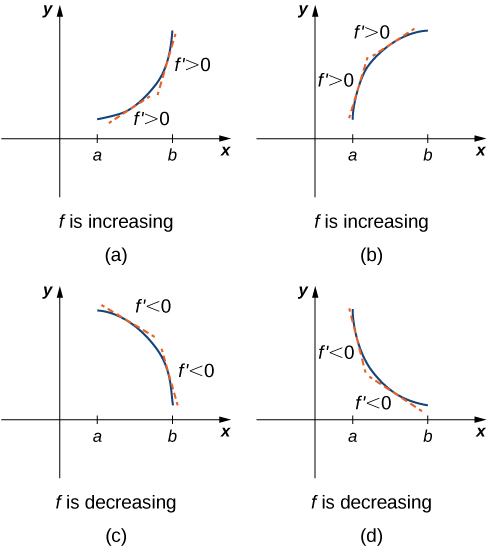
 At each point
  the derivative
  Both functions are decreasing over the interval At each point the derivative
A continuous function has a local maximum at point if and only if switches from increasing to decreasing at point  Similarly, has a local minimum at if and only if switches from decreasing to increasing at If is a continuous function over an interval containing and differentiable over except possibly at the only way can switch from increasing to decreasing (or vice versa) at point is if
  changes sign as
  increases through If is differentiable at the only way that
  can change sign as increases through is if
  Therefore, for a function that is continuous over an interval containing and differentiable over except possibly at the only way can switch from increasing to decreasing (or vice versa) is if
  or
or  is undefined. Consequently, to locate local extrema for a function
  we look for points in the domain of such that or is undefined. Recall that such points are called critical points of
Note that need not have a local extrema at a critical point. The critical points are candidates for local extrema only. In (Figure), we show that if a continuous function has a local extremum, it must occur at a critical point, but a function may not have a local extremum at a critical point. We show that if has a local extremum at a critical point, then the sign of switches as increases through that point.
Using (Figure), we summarize the main results regarding local extrema.
This result is known as the first derivative test.
We can summarize the first derivative test as a strategy for locating local extrema.
Now let's look at how to use this strategy to locate all local extrema for particular functions.
Using the First Derivative Test to Find Local Extrema
Use the first derivative test to find the location of all local extrema for  Use a graphing utility to confirm your results.
Use the first derivative test to locate all local extrema for 
Solution
has a local minimum at -2 and a local maximum at 3.
Using the First Derivative Test
Use the first derivative test to find the location of all local extrema for  Use a graphing utility to confirm your results.
Use the first derivative test to find all local extrema for ![f(x)=\sqrt[3]{x-1}.](https://opentextbc.ca/calculusv1openstax/wp-content/ql-cache/quicklatex.com-f4d0cbb30913f4a144f2d71099e53ee3_l3.png "Rendered by QuickLaTeX.com")
Concavity and Points of Inflection
We now know how to determine where a function is increasing or decreasing. However, there is another issue to consider regarding the shape of the graph of a function. If the graph curves, does it curve upward or curve downward? This notion is called the concavity of the function.
(Figure)(a) shows a function with a graph that curves upward. As increases, the slope of the tangent line increases. Thus, since the derivative increases as increases, is an increasing function. We say this function is concave up. (Figure)(b) shows a function that curves downward. As increases, the slope of the tangent line decreases. Since the derivative decreases as increases, is a decreasing function. We say this function is concave down.
In general, without having the graph of a function how can we determine its concavity? By definition, a function is concave up if is increasing. From Corollary 3, we know that if is a differentiable function, then is increasing if its derivative  Therefore, a function that is twice differentiable is concave up when Similarly, a function is concave down if is decreasing. We know that a differentiable function is decreasing if its derivative
  Therefore, a twice-differentiable function is concave down when Applying this logic is known as the concavity test.
We conclude that we can determine the concavity of a function by looking at the second derivative of In addition, we observe that a function can switch concavity ((Figure)). However, a continuous function can switch concavity only at a point if  or
or  is undefined. Consequently, to determine the intervals where a function is concave up and concave down, we look for those values of where or is undefined. When we have determined these points, we divide the domain of into smaller intervals and determine the sign of
  over each of these smaller intervals. If changes sign as we pass through a point then changes concavity. It is important to remember that a function may not change concavity at a point even if or is undefined. If, however, does change concavity at a point
  and is continuous at
  we say the point
  is an inflection point of
Testing for Concavity
We now summarize, in (Figure), the information that the first and second derivatives of a function provide about the graph of and illustrate this information in (Figure).
Sign of  | Sign of | Is increasing or decreasing? | Concavity |
|---|---|---|---|
| Positive | Positive | Increasing | Concave up |
| Positive | Negative | Increasing | Concave down |
| Negative | Positive | Decreasing | Concave up |
| Negative | Negative | Decreasing | Concave down |
The Second Derivative Test
The first derivative test provides an analytical tool for finding local extrema, but the second derivative can also be used to locate extreme values. Using the second derivative can sometimes be a simpler method than using the first derivative.
We know that if a continuous function has a local extrema, it must occur at a critical point. However, a function need not have a local extrema at a critical point. Here we examine how the second derivative test can be used to determine whether a function has a local extremum at a critical point. Let be a twice-differentiable function such that  and is continuous over an open interval containing
  Suppose
  Since is continuous over
  for all
  ((Figure)). Then, by Corollary 3, is a decreasing function over Since
  we conclude that for all
  if
if  and
and  if
if  Therefore, by the first derivative test, has a local maximum at
  On the other hand, suppose there exists a point
  such that
  but
but  Since is continuous over an open interval containing
  then
then  for all ((Figure)). Then, by Corollary
  is an increasing function over Since
  we conclude that for all
  if
if  and
and  if
if  Therefore, by the first derivative test, has a local minimum at
Note that for case iii. when  then may have a local maximum, local minimum, or neither at For example, the functions
 and
and  all have critical points at In each case, the second derivative is zero at However, the function
  has a local minimum at whereas the function has a local maximum at and the function does not have a local extremum at
Let's now look at how to use the second derivative test to determine whether has a local maximum or local minimum at a critical point where
Using the Second Derivative Test
Use the second derivative to find the location of all local extrema for 
We have now developed the tools we need to determine where a function is increasing and decreasing, as well as acquired an understanding of the basic shape of the graph. In the next section we discuss what happens to a function as  At that point, we have enough tools to provide accurate graphs of a large variety of functions.
Key Concepts
2. For the function  is both an inflection point and a local maximum/minimum?
Solution
It is not a local maximum/minimum because does not change sign
3. For the function is an inflection point?
4. Is it possible for a point to be both an inflection point and a local extrema of a twice differentiable function?
5. Why do you need continuity for the first derivative test? Come up with an example.
6. Explain whether a concave-down function has to cross  for some value of
Solution
False; for example, 
7. Explain whether a polynomial of degree 2 can have an inflection point.
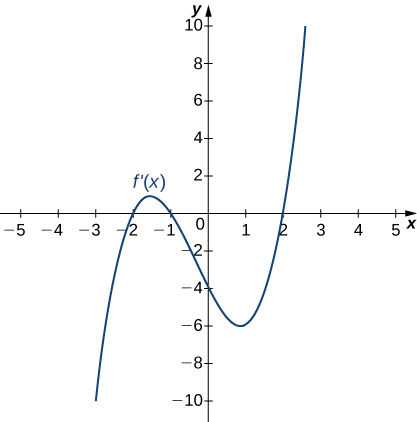
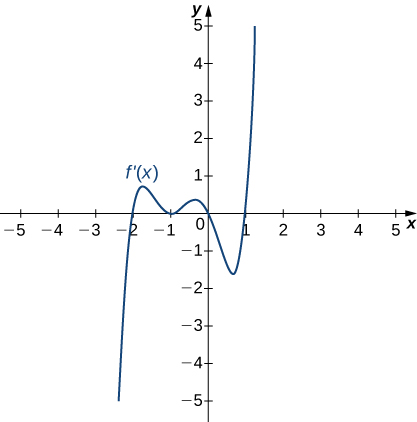
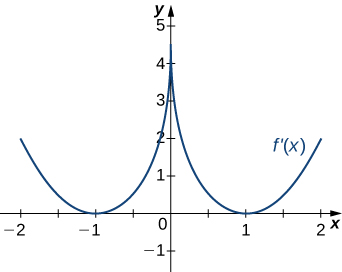
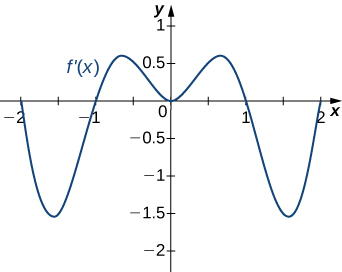
For the following exercises, analyze the graphs of  then list all intervals where is increasing or decreasing.
8.
9. 
10. 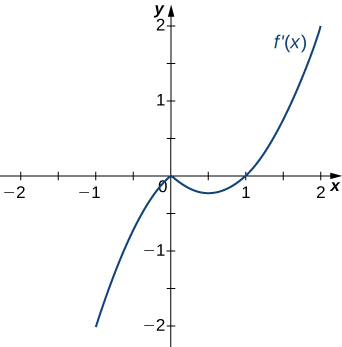
Solution
Decreasing for  increasing for
11.
12.
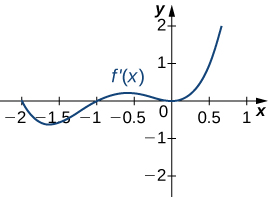
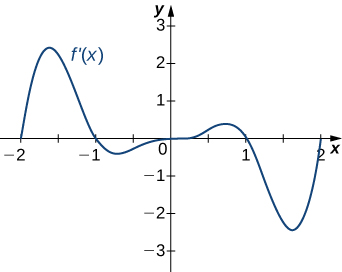
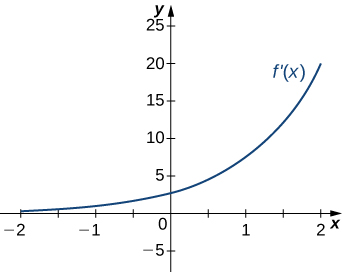
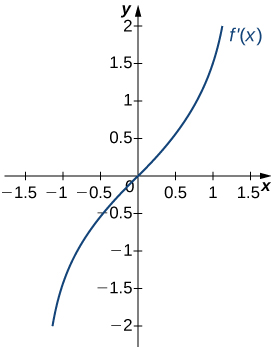
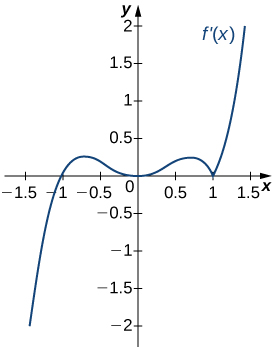
For the following exercises, analyze the graphs of then list all intervals where
- is increasing and decreasing and
- the minima and maxima are located.
13.
14.
15.
16.
17.
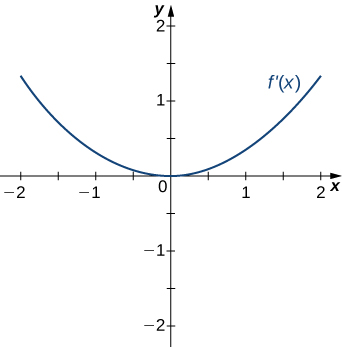
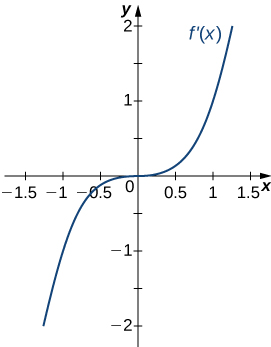
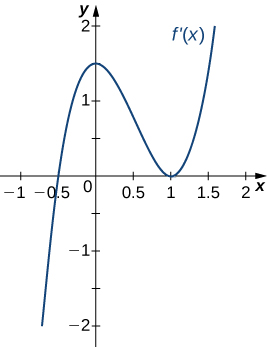
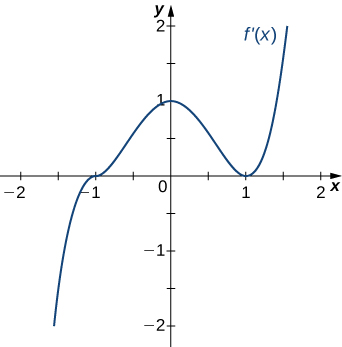
For the following exercises, analyze the graphs of then list all inflection points and intervals that are concave up and concave down.
18.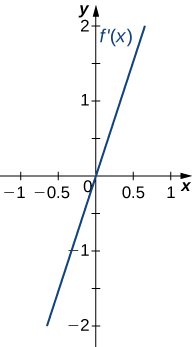
Solution
Concave up on all no inflection points
19.
20.
Solution
Concave up on all no inflection points
21.
22.
For the following exercises, draw a graph that satisfies the given specifications for the domain ![x=\left[-3,3\right].](https://opentextbc.ca/calculusv1openstax/wp-content/ql-cache/quicklatex.com-b487aeabb7b170f383ccd6c85627f3df_l3.png "Rendered by QuickLaTeX.com") The function does not have to be continuous or differentiable.
The function does not have to be continuous or differentiable.
24. over  over
over  for all
Solution
Answers will vary
26. There is a local maximum at  local minimum at
  and the graph is neither concave up nor concave down.
Solution
Answers will vary
For the following exercises, determine
- intervals where is increasing or decreasing and
- local minima and maxima of
28.  over
over 
29. 
For the following exercises, determine a. intervals where is concave up or concave down, and b. the inflection points of
30. 
For the following exercises, determine
- intervals where is increasing or decreasing,
- local minima and maxima of
- intervals where is concave up and concave down, and
- the inflection points of
31. 
32. 
33. 
34. 
35. 
36. 
37. 
For the following exercises, determine
- intervals where is increasing or decreasing,
- local minima and maxima of
- intervals where is concave up and concave down, and
- the inflection points of Sketch the curve, then use a calculator to compare your answer. If you cannot determine the exact answer analytically, use a calculator.
38. [T]  over
over ![x=\left[-1,1\right]](https://opentextbc.ca/calculusv1openstax/wp-content/ql-cache/quicklatex.com-608c6475e5939b6784e4bc9d6b548695_l3.png "Rendered by QuickLaTeX.com")
39. [T]  over
over ![x=\left[-\frac{\pi }{2},\frac{\pi }{2}\right]](https://opentextbc.ca/calculusv1openstax/wp-content/ql-cache/quicklatex.com-87ae8b58352ed89b49269444410dd85b_l3.png "Rendered by QuickLaTeX.com")
40. [T]  over
over 
41. [T] 
42. [T] 
44.  over
over ![x=\left[\text{−}\pi ,\pi \right]](https://opentextbc.ca/calculusv1openstax/wp-content/ql-cache/quicklatex.com-ec78582876326c64ccdfe4b3ce8fcb25_l3.png "Rendered by QuickLaTeX.com")
45. 
46. 
47. 
For the following exercises, interpret the sentences in terms of 
48. The population is growing more slowly. Here is the population.
Solution

49. A bike accelerates faster, but a car goes faster. Here  Bike's position minus Car's position.
50. The airplane lands smoothly. Here is the plane's altitude.
Solution

51. Stock prices are at their peak. Here is the stock price.
52. The economy is picking up speed. Here is a measure of the economy, such as GDP.
Solution

For the following exercises, consider a third-degree polynomial  which has the properties
  Determine whether the following statements are true or false. Justify your answer.
53.  for some
54. for some
Solution
True, by the Mean Value Theorem
55. There is no absolute maximum at 
56. If  has three roots, then it has 1 inflection point.
Solution
True, examine derivative
57. If has one inflection point, then it has three real roots.
A Function Can Have More Than One Point Where Derivative Is Zero
Source: https://opentextbc.ca/calculusv1openstax/chapter/derivatives-and-the-shape-of-a-graph/
0 Response to "A Function Can Have More Than One Point Where Derivative Is Zero"
Post a Comment